
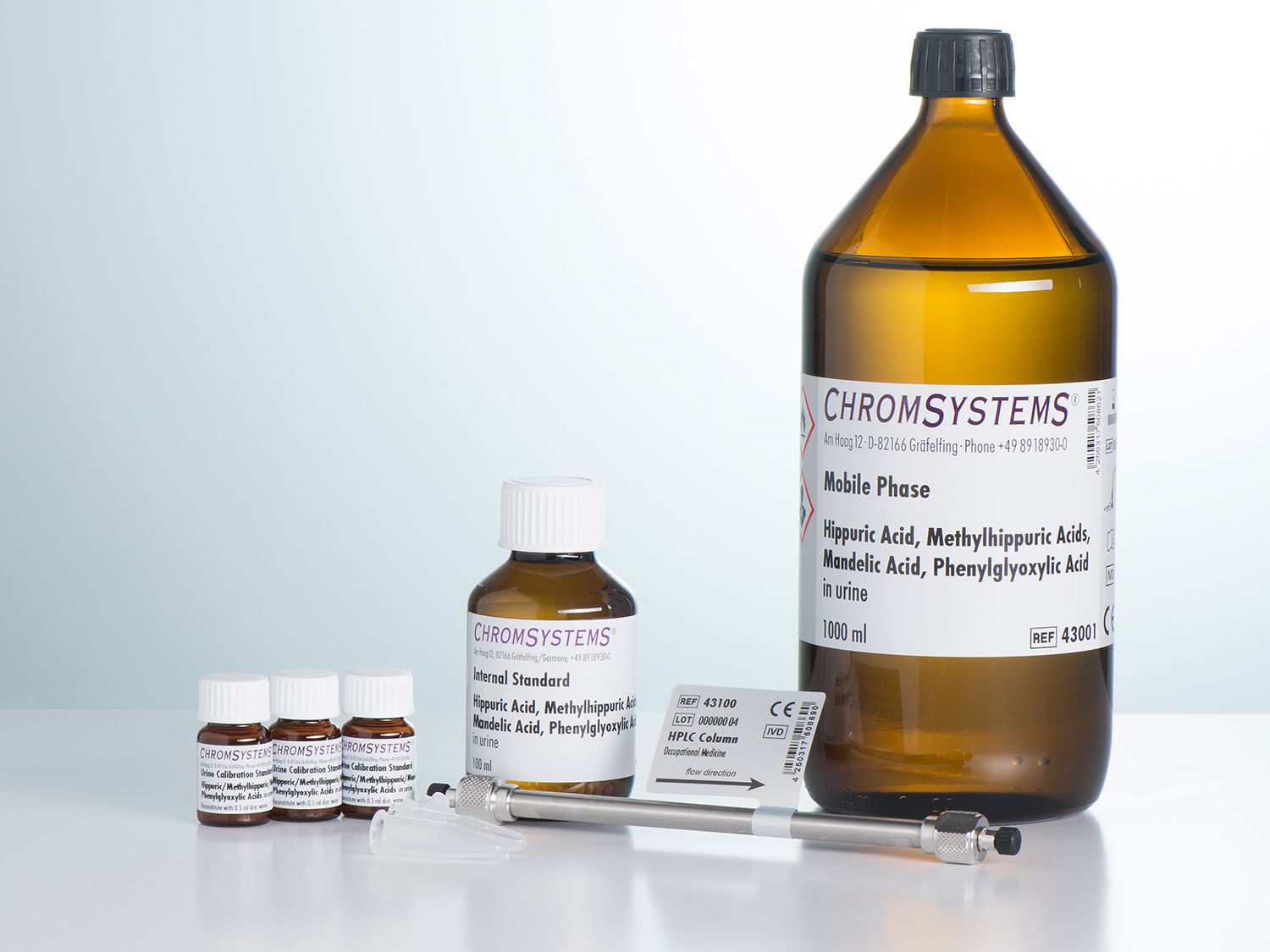
Hippuric Acid, Methylhippuric Acids, Mandelic Acid and Phenylglyoxylic Acid in Urine - HPLC
Only 10 µl sample volume
Internal standard included
Simple sample preparation
CE-IVD validated product ready for IVDR within timeframes and transition periods specified by the IVDR 2017/746 (=> Declaration of Conformity)
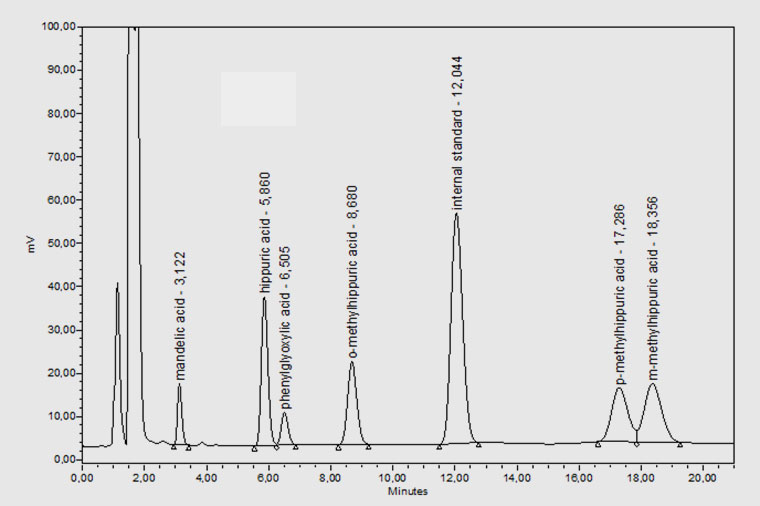
Hippuric Acid
Mandelic Acid
o-Methylhippuric Acid
m-Methylhippuric Acid
p-Methylhippuric Acid
Phenylglyoxylic Acid
Clinical relevance
Hippuric acid, o-, m-, p-methylhippuric acid, mandelic acid and phenylglyoxylic acid are the main metabolites of the organic solvents: toluene, xylene, and styrene. These toxic compounds are widely used throughout various industries, making the determination of their concentrations relevant to occupational health in a number of different professional fields. Due to their high levels of volatility, they primarily enter the body through inhalation and are rapidly absorbed through the lungs. For occupational health monitoring of people who are exposed to these compounds at work, measurement of the metabolites in urine is more reliable than determining the concentrations of the toxins in the blood, due to their very fast metabolism rates.
For any hazardous substance or its metabolite, a BTV (Biological Tolerance Value) is defined as a threshold value for maximum absorption in biological material. Solvent-related harm to human health can be prevented by performing regular monitoring of urine.
The Chromsystems assay
This assay allows the simultaneous quantitative determination of hippuric acid, ortho-, meta-, and para -methylhippuric acid, mandelic acid as well as phenylglyoxylic acid in patient urine samples by HPLC.
It is intended as a test for patients whose levels of metabolites in urine act as a marker of styrene, toluene or xylene are exposed following an occupational medicine investigation should be monitored.
Detailed performance data for this assay can be found in the appendix of the instruction manual.
| Method of Analysis | HPLC |
|---|---|
| Number of Tests | 100 |
| Please note | The information listed here, including the sample preparation, is not sufficient for using the product. Please read the information provided in the instruction manual, which includes detailed information on limitations associated with the use of the product in line with its intended purpose. Detailed performance data can be found in the appendix of the instruction manual. |
| Lower and Upper Limit of Quantitation | Mandelic acid: 1.6 - 5190 mg/L |
| BEI values | Hippuric acid: no values available |
| Specimen | Urine, collected after end of shift |
| Sample Preparation | The information on the sample preparation presented here is not sufficient for use in the laboratory. For a detailed step by step description, please refer to the instruction manual. • Place 1000 µl Internal Standard into reaction vial. |
| Run Time | 20 min |
| Injection Volume | 20 µl |
| Flow Rate | 1.5 ml/min |
| Column Temperature | ambient (approx. 25 °C) |
| Wavelengths | 207 nm |
| Additional Info | Any isocratic HPLC system with UV detector is suitable. |
| Parameters | Hippuric Acid, m-Methylhippuric Acid, Mandelic Acid, o-Methylhippuric Acid, p-Methylhippuric Acid, Phenylglyoxylic Acid |
-
 Mobile PhaseOrder No.: 43011Hippuric Acid, Methylhippuric Acids, Mandelic Acid and Phenylglyoxylic Acid in Urine - HPLC
 -
 Occupational Medicine Urine Calibration StandardOrder No.: 43003Hippuric Acid, Methylhippuric Acids, Mandelic Acid and Phenylglyoxylic Acid in Urine - HPLC
 -
 Internal StandardOrder No.: 43004Hippuric Acid, Methylhippuric Acids, Mandelic Acid and Phenylglyoxylic Acid in Urine - HPLC
-
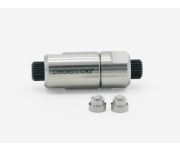
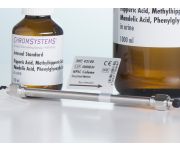 HPLC Column Hippuric Acid, Methylhippuric Acids, Mandelic Acid and Phenylglyoxylic Acid in UrineOrder No.: 43100Hippuric Acid, Methylhippuric Acids, Mandelic Acid and Phenylglyoxylic Acid in Urine - HPLC
-
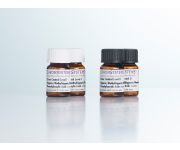
Occupational Medicine Urine Calibration StandardOrder No.: 43003Hippuric Acid, Methylhippuric Acids, Mandelic Acid and Phenylglyoxylic Acid in Urine - HPLC
-
HPLC Column Hippuric Acid, Methylhippuric Acids, Mandelic Acid and Phenylglyoxylic Acid in UrineOrder No.: 43100Hippuric Acid, Methylhippuric Acids, Mandelic Acid and Phenylglyoxylic Acid in Urine - HPLC
Hippuric Acid
Mandelic Acid
o-Methylhippuric Acid
m-Methylhippuric Acid
p-Methylhippuric Acid
Phenylglyoxylic Acid
Clinical relevance
Hippuric acid, o-, m-, p-methylhippuric acid, mandelic acid and phenylglyoxylic acid are the main metabolites of the organic solvents: toluene, xylene, and styrene. These toxic compounds are widely used throughout various industries, making the determination of their concentrations relevant to occupational health in a number of different professional fields. Due to their high levels of volatility, they primarily enter the body through inhalation and are rapidly absorbed through the lungs. For occupational health monitoring of people who are exposed to these compounds at work, measurement of the metabolites in urine is more reliable than determining the concentrations of the toxins in the blood, due to their very fast metabolism rates.
For any hazardous substance or its metabolite, a BTV (Biological Tolerance Value) is defined as a threshold value for maximum absorption in biological material. Solvent-related harm to human health can be prevented by performing regular monitoring of urine.
The Chromsystems assay
This assay allows the simultaneous quantitative determination of hippuric acid, ortho-, meta-, and para -methylhippuric acid, mandelic acid as well as phenylglyoxylic acid in patient urine samples by HPLC.
It is intended as a test for patients whose levels of metabolites in urine act as a marker of styrene, toluene or xylene are exposed following an occupational medicine investigation should be monitored.
Detailed performance data for this assay can be found in the appendix of the instruction manual.
| Method of Analysis | HPLC |
|---|---|
| Number of Tests | 100 |
| Please note | The information listed here, including the sample preparation, is not sufficient for using the product. Please read the information provided in the instruction manual, which includes detailed information on limitations associated with the use of the product in line with its intended purpose. Detailed performance data can be found in the appendix of the instruction manual. |
| Lower and Upper Limit of Quantitation | Mandelic acid: 1.6 - 5190 mg/L |
| BEI values | Hippuric acid: no values available |
| Specimen | Urine, collected after end of shift |
| Sample Preparation | The information on the sample preparation presented here is not sufficient for use in the laboratory. For a detailed step by step description, please refer to the instruction manual. • Place 1000 µl Internal Standard into reaction vial. |
| Run Time | 20 min |
| Injection Volume | 20 µl |
| Flow Rate | 1.5 ml/min |
| Column Temperature | ambient (approx. 25 °C) |
| Wavelengths | 207 nm |
| Additional Info | Any isocratic HPLC system with UV detector is suitable. |
| Parameters | Hippuric Acid, m-Methylhippuric Acid, Mandelic Acid, o-Methylhippuric Acid, p-Methylhippuric Acid, Phenylglyoxylic Acid |
-
Mobile PhaseOrder No.: 43011Hippuric Acid, Methylhippuric Acids, Mandelic Acid and Phenylglyoxylic Acid in Urine - HPLC
-
Occupational Medicine Urine Calibration StandardOrder No.: 43003Hippuric Acid, Methylhippuric Acids, Mandelic Acid and Phenylglyoxylic Acid in Urine - HPLC
-
Internal StandardOrder No.: 43004Hippuric Acid, Methylhippuric Acids, Mandelic Acid and Phenylglyoxylic Acid in Urine - HPLC
-
HPLC Column Hippuric Acid, Methylhippuric Acids, Mandelic Acid and Phenylglyoxylic Acid in UrineOrder No.: 43100Hippuric Acid, Methylhippuric Acids, Mandelic Acid and Phenylglyoxylic Acid in Urine - HPLC
-
Occupational Medicine Urine Calibration StandardOrder No.: 43003Hippuric Acid, Methylhippuric Acids, Mandelic Acid and Phenylglyoxylic Acid in Urine - HPLC
-
HPLC Column Hippuric Acid, Methylhippuric Acids, Mandelic Acid and Phenylglyoxylic Acid in UrineOrder No.: 43100Hippuric Acid, Methylhippuric Acids, Mandelic Acid and Phenylglyoxylic Acid in Urine - HPLC