
 Download as pdf
 Introduction
Drugs of abuse are defined as substances that are consumed not for the treatment of disease, but for their mind-altering effects. This definition is not limited to illegal drugs; it also includes approved pharmaceuticals with abuse or habit-forming potential. Substances in this category include amphetamines, barbiturates, benzodiazepines, booster, cocaine, cannabinoids, opiates/opioids, Z-Drugs and other drugs of abuse,.
Here we describe a simple and quick adaptation of the MassTox® Drugs of Abuse Testing in urine kit (order no. 96000) to enable the analysis of 108 substances in venous whole blood. The changes only affect sample preparation, while the analytical system can remain completely unchanged.
Material and Methods
Reconstitution of calibrators/controls
Prior to sample preparation a 6PLUS1® Multilevel Calibrator Set (order no. 96039/0-6) and MassCheck® Control Level I-III (REF 0410, 0420, 0430) were reconstituted in combination with analyte-free lyophilised whole blood as follows:
- For calibrators 8.0 mL Reconstitution Buffer (order no. 96023) was pipetted into lyophilised analyte-free whole blood and exactly 1.0 mL of the reconstituted analyte-free whole blood was added into each vial of the calibrator and reconstituted it for 10 to 15 min at +20 to +25°C swirling repeatedly.
- For each control level 2.5 mL Reconstitution Buffer (order no. 96024) was pipetted into lyophilised analyte-free whole blood and exactly 1.0 mL of the reconstituted analyte-free whole blood was added into each vial of the control level and reconstituted it for 10 to 15 min at +20 to +25°C swirling repeatedly.
Dilution of Calibrator Level 1 with analyte-free whole blood may be required in order to meet legal requirements for blood analysis.
Sample Preparation
The sample preparation procedure was performed in accordance with the MassTox® Drugs of Abuse protocol for urine, omitting the hydrolysis step (hydrolysis is not required for whole blood samples). To compensate for the volume, 40 µL of Dilution Buffer (order no. 96010) was added instead:
- 50 µL of sample/calibrator/control was placed into a 1.5 mL reaction vial, adding 10 µL of the reconstituted Internal Standard Mix (order no. 96046) and 40 µL Dilution Buffer (order no. 96010), then mixing it for 2 s (vortex)
- 100 µL Precipitation Reagent (order no. 96005) was then added, mixing it for 2 s (vortex) and centrifuged it for 5 min at 15000 x g
- 150 µL Dilution Buffer (order no. 96010) was pipetted into an autosampler vial and 100 µL of the sample supernatant was added
- The closed autosampler vial was mixed for 2 s (vortex) prior to injection of the prepared sample into the LC-MS/MS system
LC-MS/MS
For the LC-MS/MS method und analytical column, there are no changes to the original method required. Chromatographic separation was performed on an Analytical Column (order no. 96100) at a column temperature of 30 °C. The analytes are separated with a gradient profile at a flow rate of 0.4 mL/min using Mobile Phase A (order no. 96001) and Mobile Phase B (order no. 96002). See Table 1.
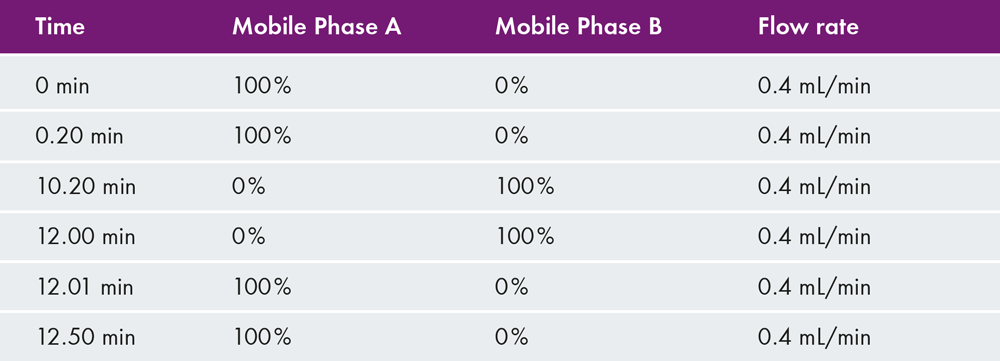
Table 1: Gradient profile
Quantification
For calibration and quality control, the Urine Calibration Set 96040 and MassCheck® Control Level I-III 0410, 0420 and 0430 were used, with following modification: Instead of the contained lyophilised urine matrix, we used lyophilised whole blood.
Calibration curves were constructed by calculating the analyte to internal standard (ISTD) peak area ratio on the y axis against calibrator concentrations on the x axis. Then a calibration curve was plotted using linear regression and 1/x2 weighting.
Results
The run time is 12.5 min (see chromatograms in fig. 1 + 2). The calibration range covers the forensic and clinical relevant concentrations (table 3). One limitation of the method is that the determination of THC and 11-OH-THC is not possible, as these analytes were not included in the calibrators used.
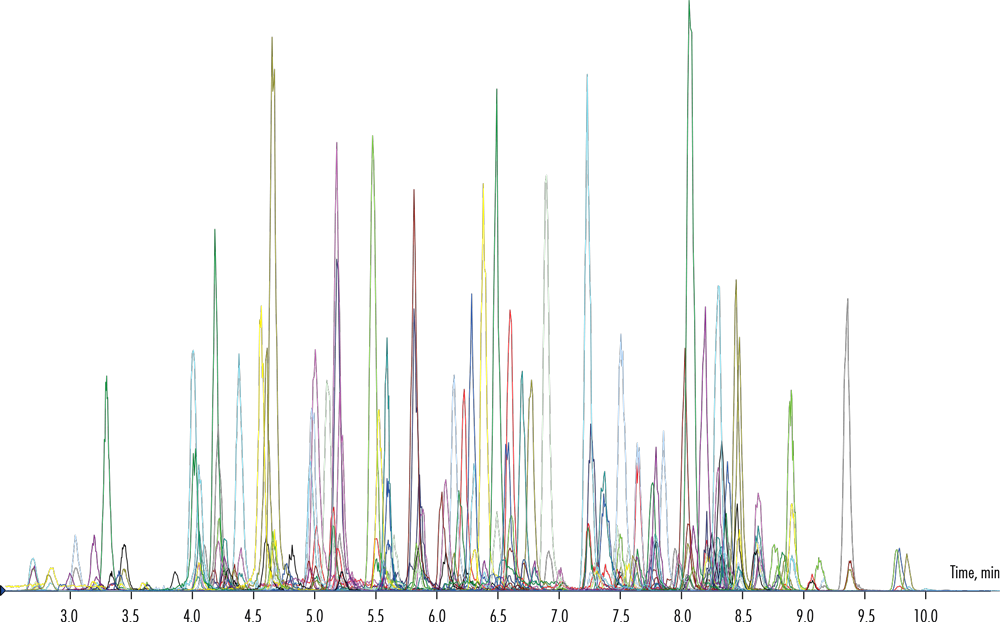
Fig. 1: ESI positive
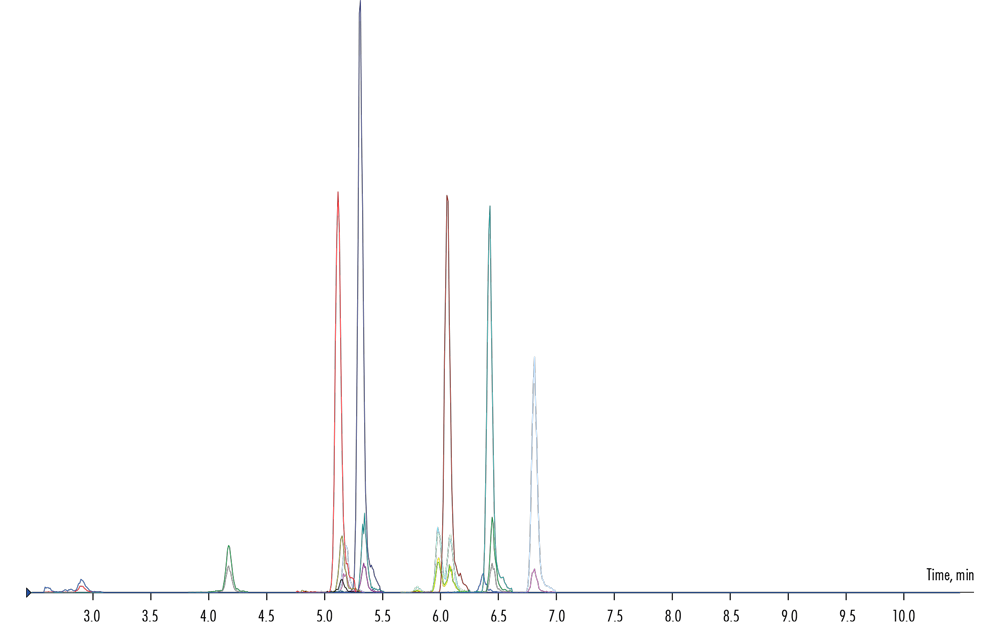
Fig 2: ESI negative
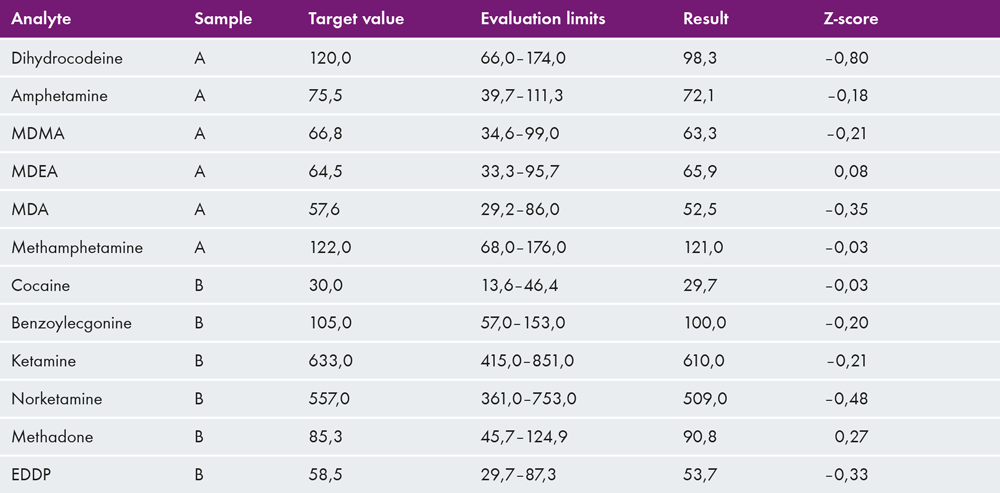
Table 3
In table 3 results of Arvecon proficiency scheme are presented.
The scheme is passed for all analytes. The unit is µg/L
The application of this method has already been tested with several hundred whole blood samples. No difficulties or equipment problems such as contamination were observed. Analysis of whole blood samples can also be performed in conjunction with urine samples using the original assay.
Conclusion
This application note describes a protocol for the determination of drugs of abuse in whole blood using a slightly modified version of the Chromsystems kit 96000 MassTox® Drugs of Abuse in Urine, while retaining the components of the original method.
Furthermore, the kit has also been tested using other postmortem matrices such as vitreous humor and different organ blood, yielding promising results.
Please note: This workflow describes a use that is not covered by the intended purpose of the product. The procedure has not been validated by the manufacturer and is not intended for diagnostic use. All responsibility for performance, suitability and regulatory compliance lies with the user.
Last Update March 2026