
 Download as pdf
 Introduction
Material & Methods
Sample Preparation
Prior to sample preparation, the Internal Standard Solution is prepared by mixing the Internal Standard Mix (order no. 63004) and the Extraction Reagent (Order No. 63005) in an appropriate ratio of 1:9.
For sample preparation, 100 μl of Internal Standard Solution is pipetted into a 1.5 mL reaction vial. Subsequently, 20 μl of sample/calibrator/MassCheck® control is added and vortexed for 5 seconds, followed by centrifugation for 10 minutes at 15,000 g. The resulting supernatant is transferred into an autosampler vial.
LC-MS/MS
Injection volume of 1–20 µl is used. Chromatographic separation is performed on an Analytical Column (order no. 63100) at a column temperature of 40 °C. The analytes are separated under isocratic conditions at a flow rate of 0.4 ml/min using Mobile Phase (order no. 63001).
Electrospray ionization in negative ion mode is used. The multiple reaction monitoring (MRM) transitions used for quantification are listed in Table 1.
Quantification
A full calibration of the analysis system for each series of measurements is performed with 6PLUS1® multi level calibrator (order no. 63039). Calibration curves are constructed by calculating the analyte to internal standard (ISTD) peak area ratio on the y axis against calibrator concentrations on the x axis. Then a calibration curve is plotted for both PEth homolouges using linear regression and 1/x weighting.

Table 1: Multiple reaction monitoring transitions of Phosphatidylethanol 16:0/18:1 and 16:0/18:2, together with their respective internal standards

Table 2: Interpretation of Phosphatidylethanol 16:0/18:1 values
Results
The run time is 3.5 min (see chromatogram in fig. 1). The calibration range of 10-1000 ng/mL covers the forensic and clinical relevant concentrations (table 2).
Conclusion
This product insight describes a protocol for the determination of PEth 16:0/18:1 and PEth 16:0/18:2 in whole blood using Chromsystems components. Suitable products for implementation in your laboratory will soon be available from Chromsystems.
Outlook
Further research will focus on developing a reliable protocol for automated sample preparation using 96-well plates and liquid handling systems.
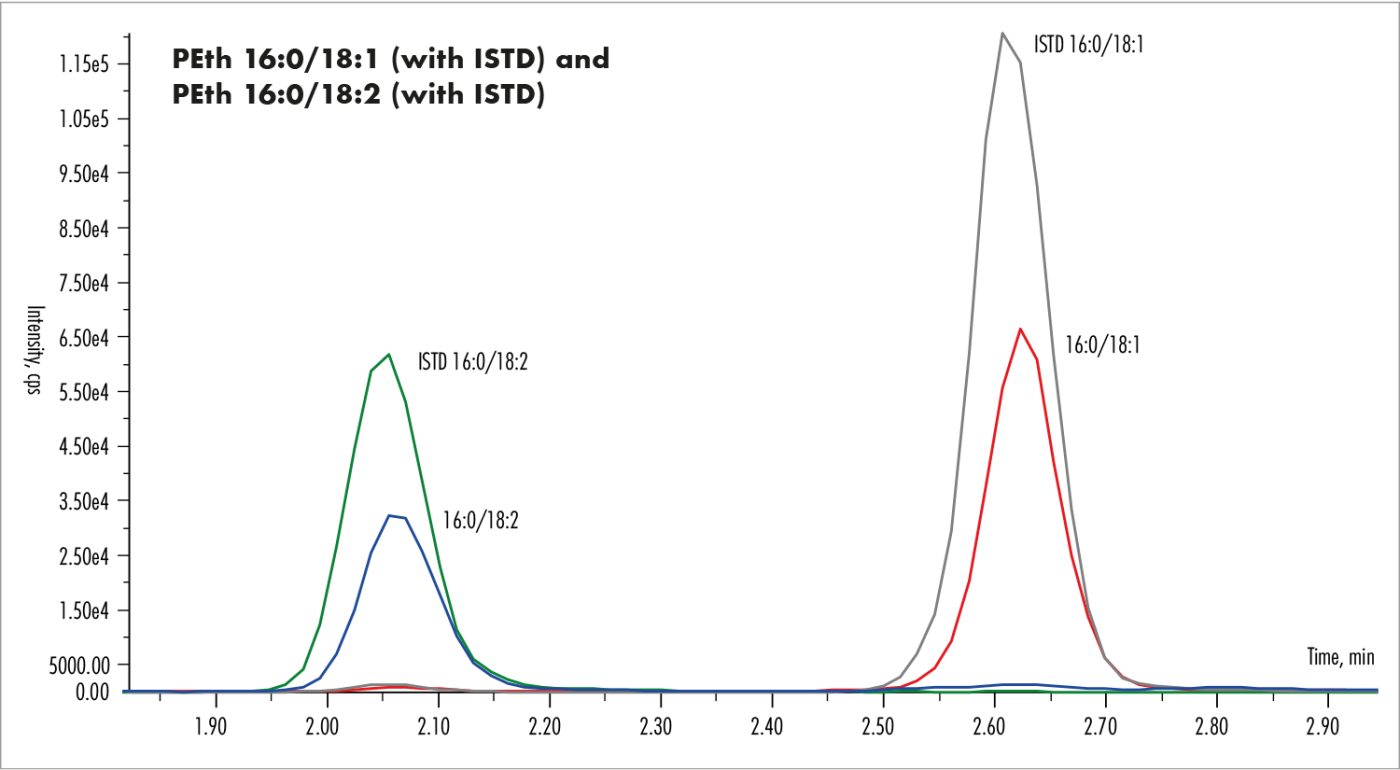
Fig. 1: Chromatogram of phosphatidylethanol 16:0/18:1 and 16:0/18:2 at a concentration of 300 ng/mL each, with their respective internal standards

Fig. 2: Chemical structure of Phosphatidylethanol 16:0/18:1 and 16:0/18:2
The following products have been released and can be ordered (More are to come)
The following products have been released and can be ordered (More are to come)
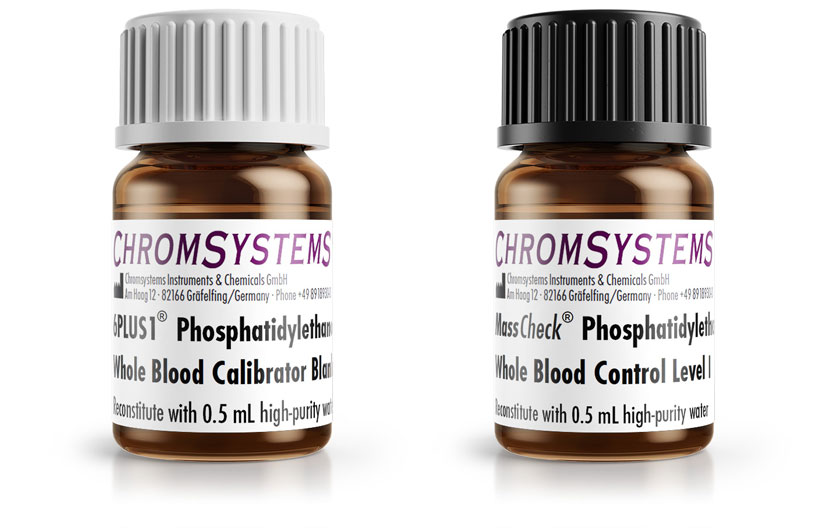
Regulatory status: For research use only (RUO).
Further products are currently being developed. Please contact your local reprensentative for further information
| Product | Order no. |
| Mobile Phase | 63001 |
| Rinsing Solution | 63009 |
| Internal Standard Mix | 63004 |
| Extraction Reagent | 63005 |
| Tuning Mix, Analytes and Internal Standards | 63015 |
| Analytical Column | 63100 |
| Product | Order no. |
| 6PLUS1® Multilevel Whole Blood Calibrator Set MassChrom® Phosphatidylethanol (PEth) |
63039 |
| MassCheck® Phosphatidylethanol (PEth) Whole Blood Control Set Level I |
6310 |
| MassCheck® Phosphatidylethanol (PEth) Whole Blood Control Set Level II |
6320 |
Last Update March 2026